How to Propagate Clematis from Cuttings and Layering

42.1K
841
151
2025-10-31
How to Propagate Clematis from Cuttings and Layering

Create more of your favorite varieties for free by learning how to propagate clematis. These hardy perennial vines come in hundreds of varieties that offer a diversity of colors and forms. If you were to collect and sprout seeds from your clematis, you may get plants that don't look like your original plant. To grow new plants that look exactly like the original variety, two of the best propagation methods to use are cuttings and layering. Follow this simple step-by-step guide to propagate clematis vines from layered stems or by rooting cuttings.

Propagating Clematis by Layering

Perhaps the easiest and most natural way to propagate clematis is by layering. Layering is a process by which plants sprout roots directly from their stems upon contact with soil. This technique may not work as well in cold climates where stems die back to the ground each winter.

Step 1: Select stems to layer.

Identify new, flexible stems in spring and lower them to the soil surface, whether in pots or onto the ground. Depending on the stem’s length, you might be able to create multiple clones along the length of the stem.

Step 2: Prepare stems.

Using a sharp knife, make a small cut into one side of each selected stem where it will make contact with soil. You can also apply a little powdered rooting hormone to the cut part of the stem. 

Step 3: Cover the stems with soil.

Whether in the ground or in a nearby pot, press the cut part of each stem against the soil and lightly cover with about a half-inch to an inch of soil.

Step 4: Secure the stems in place.

Hold the buried portion of each stem in place beneath the soil with a small rock, garden pins, or a broken piece of pottery. Repeat the process if a stem is long enough to produce more than one plant, spacing them at least 6 inches apart.

Step 5: Water and wait.

Keep the buried portions of stem moist and disturb them as little as possible.

Step 6: Watch for new growth.

Over the course of one or two years, plantlets are likely to develop. Once you see new growth, cut the stem that attaches them to the parent plant to create fully independent plants. Gently dig up the new clematis vines and move them to where you want them to grow.

Propagating Clematis by Cuttings

Stem cuttings are a great way to make more clematis plants that usually grow within a single season.

Not all cuttings will take root and grow, so take several for success. Less than 50 percent of cuttings taking root is considered normal.

Step 1: Select stems of new growth.

Take softwood cuttings from newer, softer stems in late spring. Identify stems that have just begun to harden for best results. These stems are ready and capable of producing roots of their own.

Step 2: Take cuttings.

Separate the chosen stem from the rest of the plant by cutting it off at the base.

Step 3: Remove leaves.

The stem consists of a series of nodes from which leaves sprout on either side every few inches. Remove the leaves at the base of each node along the entire length of the stem, leaving some leaves above each node.

Step 4: Prepare cuttings.

Cut the stem into sections 3 to 4 inches long, making the cut just below a node. Each section should have a node, a portion of stem, and one set of leaves.

Step 5: Apply rooting hormone.

Dip about 1 inch of each section into a rooting hormone, then let them sit for a few minutes until dry.

Step 6: Plant cuttings.

Prepare a 4- or 5-inch container of moist potting soil and poke holes along the edges with a pencil or pen. Gently place cuttings into the soil and press the soil against the stems, holding them in place. 

Step 7: Care for cuttings until they root.

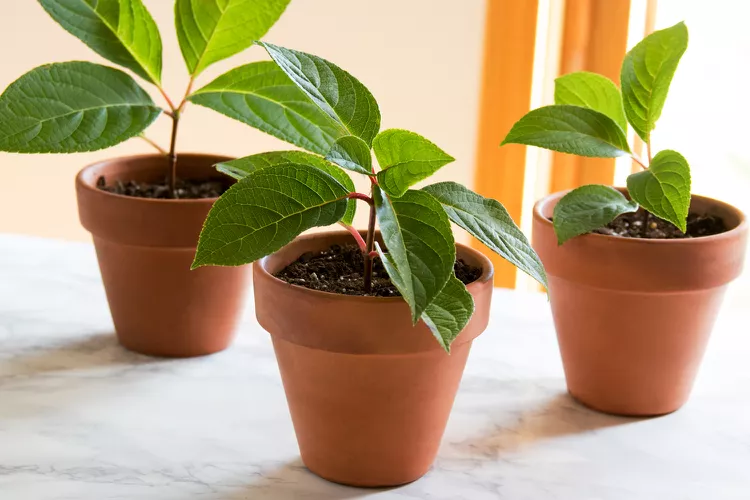
Place the planted cuttings in bright, indirect light, dappled shade, or under artificial lighting, and keep the potting soil moist. Cuttings should root and begin to produce new growth within two to three months, depending on climate and other environmental conditions. 

Caring for Your Clematis Cuttings

Once the cuttings have begun to take root and grow, move them to individual pots and provide plenty of sunlight and moisture. Apply light doses of an organic fertilizer following the product instructions to help the new plants grow and prepare for the following season. 

As the clematis cuttings begin to mature in about a year, plant them in the garden. Established cuttings are just as hardy as their parent plants and need the same amount of care.
Related Article

How to Propagate Pothos Successfully in Soil or Water
40.9K
408
61

How to Propagate Pothos Successfully in Soil or Water

Learn how to propagate pothos plants successfully with these simple step-by-step instructions.
24 Easy-Care Houseplants With Low Watering Needs
16.7K
334
93

24 Easy-Care Houseplants With Low Watering Needs

The low-maintenance, easy-care houseplants in this collection add lushness and color to any home without needing much more than occasional watering.
How to Plant and Grow Philodendron
38.6K
772
270

How to Plant and Grow Philodendron

Find growing information on philodendron, the perfect houseplant for new plant owners.
How to Get Rid of Spider Mites on Indoor Plants
46.1K
4.1K
1.9K

How to Get Rid of Spider Mites on Indoor Plants

Spider mites are a common houseplant pest. Learn the early signs of spiders mites on your plants and how to get rid of them.
16 Small Backyard Garden Ideas for Maximizing Your Landscape
36.4K
3.3K
820

16 Small Backyard Garden Ideas for Maximizing Your Landscape

Even the tiniest landscapes can be magical outdoor spaces with these small backyard garden ideas that maximize your yard.
Here's How to Dry and Preserve Flowers to Enjoy Their Beauty Year-Round
37.9K
3K
1.2K

Here's How to Dry and Preserve Flowers to Enjoy Their Beauty Year-Round

Learn how to dry flowers with air drying, silica gel, or even the microwave. These three methods to preserve flowers are great for wreaths, bouquets, and decorating projects.
How to Clean a Hummingbird Feeder in 5 Easy Steps
9.2K
184
51

How to Clean a Hummingbird Feeder in 5 Easy Steps

Keep your garden a safe and welcoming space for hummingbirds by following our five-step guide for how to clean hummingbird feeders.
How to Plant and Grow Angelonia
7K
140
26

How to Plant and Grow Angelonia

Angelonia (or summer snapdragon) is a spectacular addition for continuous color in any garden.
How to Plant and Grow Agapanthus
18.4K
1.8K
330

How to Plant and Grow Agapanthus

Agapanthus is a low-maintenance perennial and landscape staple that produces clusters of trumpet-shaped flowers.
How to Plant and Grow Shrub Roses
40.7K
3.7K
696

How to Plant and Grow Shrub Roses

Learn to grow shrub roses, which combine all of the best characteristics of roses into a beautiful, low-maintenance plant.
11 Best Deer-Resistant Shrubs for Avoiding Browsing Damage
38.2K
1.5K
504

11 Best Deer-Resistant Shrubs for Avoiding Browsing Damage

No plant is completely safe, but these deer resistant shrubs tend to be low on the menu for hoofed garden visitors.
What's Causing Your Gardenia's Yellow Leaves? We Have Answers
16.5K
1.5K
251

What's Causing Your Gardenia's Yellow Leaves? We Have Answers

What causes your gardenia's yellow leaves? Here's the reason and how to fix it. Gardenias are high-maintenance, but this is how to make them happy.
How to Plant and Grow Jasmine
42.3K
3.8K
418

How to Plant and Grow Jasmine

Jasmine is a perennial shrub or vine beloved for its fragrant flowers. Learn how to grow it in your garden or as a houseplant.
Do Deer Eat Tomato Plants? 5 Ways to Protect Your Harvest
42.1K
1.7K
775

Do Deer Eat Tomato Plants? 5 Ways to Protect Your Harvest

Deer do eat tomato plants from time to time. Here's how to recognize deer damage on tomatoes and how to prevent the creatures from ruining your crop.
11 Simple Tips for Growing Carrots in Containers Successfully
31.7K
317
44

11 Simple Tips for Growing Carrots in Containers Successfully

Growing carrots in containers saves space and protects carrot roots from pests. Here's how to plant and grow carrots in pots.
Which Types of Garlic Are Best to Grow in Your Garden?
32.5K
3.2K
1K

Which Types of Garlic Are Best to Grow in Your Garden?

Hardneck or softneck? Here’s what to know about different types of garlic and how to grow them.
How to Plant a Mango Seed and Successfully Grow It in 5 Steps
40.3K
805
152

How to Plant a Mango Seed and Successfully Grow It in 5 Steps

Learn how to plant a mango seed and grow it with only a few basic supplies and a little time. Use this guide to grow a mango seed successfully.
What Is a Fairy Ring? And Will It Harm Your Lawn?
23.4K
2.3K
1.1K

What Is a Fairy Ring? And Will It Harm Your Lawn?

Find out what causes those mysterious circles of mushrooms on your lawn and how to prevent fairy rings.
How to Grow Plants from Cuttings to Fill More Pots for Free
32.7K
981
245

How to Grow Plants from Cuttings to Fill More Pots for Free

Use this simple propagation technique to grow new plants with stem cuttings.
Easy Lawn Repair for Patchy Grass Using Seed or Sod
10.2K
812
292

Easy Lawn Repair for Patchy Grass Using Seed or Sod

With a bit of grass seed or sod, lawn repair is easy, and you’ll soon have a lush green carpet again.