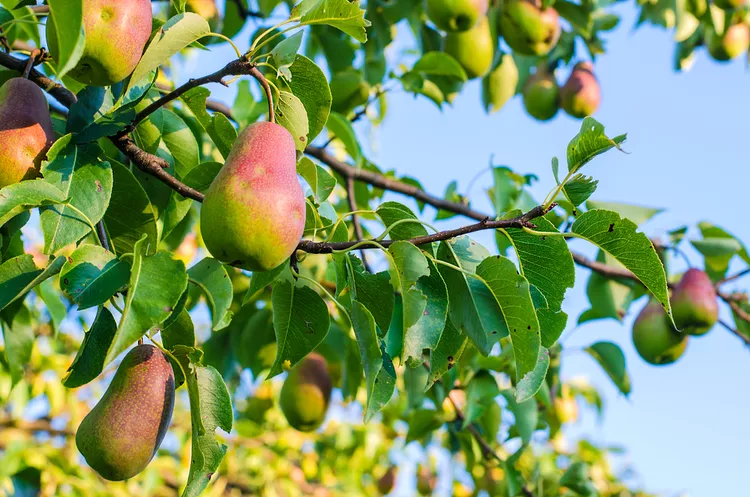
One of the most rewarding backyard fruit trees, pears are a great choice in many climates! In addition to their delicious fruit, pear trees offer pretty spring flowers and fall color. Two thriving pear trees will give you plenty of fruit over a two-to-four-week period in late summer or early fall. Choosing the right pear trees for your landscape and climate is key to ensuring a big harvest. Some types of pear trees can withstand frigid winter temperatures, while others thrive in warm regions. Plus, many of the insects and diseases that pester apple trees rarely trouble pear trees, making it easier to grow the fruit organically in your own yard. Use these tips to choose the best types of pear trees for your area.
Plant two pear varieties for best pollination.
The flowers of most pear varieties can't pollinate themselves. Instead, they must cross-pollinate with a different variety to develop fruit. A different variety of pear growing within 100 feet will provide the pollen necessary for fertilization. Plant pears in groups of two or more to make sure you get fruit. Insects are essential for transferring the pollen between plants, so avoid using pesticides around your trees while they're in bloom.
Look for fire blight resistance.
Fire blight is the most common pear disease, and isn't curable. An infected tree often dies within a couple of years unless you intervene to control the problem. Good news: several varieties are at least partially resistant to fully resistant to fire blight. When considering a pear variety, definitely give preference to one that has fire blight resistance or you may find yourself having to replace your tree in a few years.
Best Pear Trees for Cold Climates
Subzero temperatures and drying winter winds are challenging conditions for pear trees in general. However, a few types of pears can withstand the elements to produce juicy fruit year after year in Zones 3-5.
- 'Golden Spice' is one of the hardiest pears; it will survive in Zone 3. It also has excellent fire blight resistance. It produces small fruit in late summer that is good for canning as well as eating fresh. 'Ure' or 'Summercrisp' are recommended pollinators.
- 'Gourmet' is hardy to Zone 4 with moderate fire blight resistance. Its medium-size fruit ripens in early fall. It can't be used to pollinate a second tree; plant three different varieties for best fruit set.
- 'Luscious' is hardy to Zone 4 and has moderate fire blight resistance. Its small to medium-size fruits ripen in autumn and have a flavor and texture like a 'Bartlett' pear. This variety can't be used to pollinate a second tree; plant three different varieties for best fruit set.
- 'Summercrisp' is hardy to Zone 4 and resistant to fire blight. Its medium-size reddish fruit has a mild flavor and crisp texture similar to an Asian pear. 'Summercrisp' fruit ripens in late summer, but the fruit actually is better eaten fresh before fully ripe.
:strip_icc():focal(938x0:940x2):format(webp)/Seckel-pears-in-tree-MPC106447-e4a7e3f837eb47ebb217fb98ba78f24c.jpg)
:strip_icc():focal(788x608:790x610):format(webp)/Shinko-Asian-pear-HGL100876-9881e03e50784c6c93ca20234524517c.jpg)
Best Pear Trees for Warm Climates
'Bartlett' and 'Bosc' grow well in warm climates and are popular pear varieties found in grocery stores. Unfortunately, they're susceptible to fire blight so aren't the best choice for a home garden. Instead, consider the following excellent types of pear trees, which are usually divided into two categories: European, which are most like soft, juicy 'Bartlett' pears, and Asian, which have a firm, crisp texture. Count on these varieties to fruit well in Zones 5-9.
- 'Chojuro' is an Asian-type with vivid orange, russetted skin. It has a strong flavor and keeps well. For best pollination, plant it with another Asian-type.
- 'Harrow Delight' is a European-type with juicy, medium-size fruit on a productive tree.
- 'Honeysweet' is a European-type with a sweet, rich flavor and silky-smooth texture. It ripens to a golden russet hue. After harvest, refrigerate the fruit for several weeks before eating to ensure the sweetest flavor.
- 'Moonglow' is a European-type that is resistant to fire blight. In late summer, it produces medium-to-large, dull green fruit that resemble Bartlett pears in flavor and texture.
- 'Olympic' is an Asian-type pear that produces very large, russet fruit that stores well. For best pollination, plant it with another Asian-type.
- 'Orient' is a European-type with large fruit that stores well. It fruits heavily and the fruit can be used for fresh eating as well as canning.
- 'Seckel' (shown above left) is nicknamed "sugar pear" because of its very sweet flesh. It has small fruit and is one of few European pears that are ready for eating right after harvest. 'Seckel' grows well in cold climates too.
- 'Shinko' (shown above right) is an Asian-type that has firm, crisp fruit that stores well. For best pollination, plant it with another Asian-type.
Best Dwarf Pear Trees
Traditional pear trees reach lofty heights of 15 to 20 feet. Tall trees make it challenging to reach all the fruit. Dwarf and semi-dwarf pear trees, on the other hand, top out at 8 to 12 feet tall. Harvesting fruit from a dwarf or semi-dwarf tree can often be accomplished without the use of a ladder.
Dwarf and semi-dwarf trees are created by grafting the productive upper part of a young tree onto a root stock that will keep the tree small. Most of the pear trees listed above are available on dwarfing and semi-dwarfing root stocks. Read plant tags carefully or research online to find out if a variety is on a dwarf or semi-dwarf root stock. Look for a mature size designation of 8 to 12 feet tall.