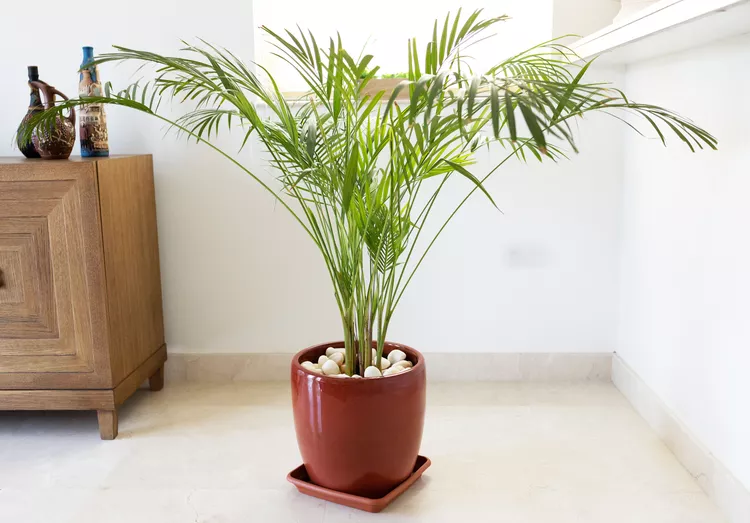
Indoor palm plants can infuse your home with a tropical feeling, reminding us of sandy beaches, sunny skies, and warm days. A potted palm also adds a bold, dramatic shape to a room. Palms are relatively easy to grow as houseplants. Give them moderate light, average humidity, and consistent moisture, and they’ll live for years. Use this list of popular indoor palm plants to find the perfect one to grow in your home.
Areca Palm
Areca palm (Chrysalidocarpus lutescens) is a fast-growing indoor palm that tolerates low light. Areca palms have large, feathery fronds on gently arching stems. They can grow 6 to 10 inches a year in the right conditions—three or four hours of bright, indirect sunlight, consistent moisture, and well-drained soil—so they can outgrow their space in a few years. Indoors, areca palms usually top out at 6 to 7 feet tall.
Fishtail Palm
Fishtail palm (Caryota spp.) has fronds with wide, ragged edges shaped like a fish tail, hence the plant's name. These palms get big—up to 20 feet tall in a pot—so they need plenty of space. Once established, they grow up to 2 feet a year.
Limit a fishtail palm’s growth by letting it get a bit root-bound; it will grow to its pot size. Fishtail palm is fussier about humidity than other indoor palms, so keep it away from air drafts. Place its container on top of a pebble tray filled with water or use a humidifier near the plant.
Fishtail palms are toxic to dogs, cats, and people if ingested.
Parlor Palm
Parlor palms (Chamaedorea elegans) have thin stems that grow in clumps and elegant feathery fronds. These and other palms in the Chamaedorea species are the classic palms featured in Victorian parlors when houseplants first became popular in the latter half of the 19th century.
Parlor palms are unfussy plants, tolerating low light and moderate humidity, which is a big part of why they are such popular houseplants. They usually stay 3 to 4 feet tall when grown in a container indoors, but they grow to their pot size, so you can keep a foot-tall parlor palm on your desk, nightstand, or other small space.
Cat Palm
Cat palm (Chamaedorea cataractarum) is one of the easiest palms to grow indoors because it needs infrequent watering and indirect light to thrive. Native to Southern Mexico and Central America, this palm grows in clumps of compact stems with wispy green fronds. Cat palms grow fuller and bushier as they mature, so put it in a corner near a window, and it will soon fill the space. It’s wide, not tall, topping out at 3 feet when grown indoors.
Kentia Palm
Kentia palm (Howea forsteriana) is native to Australia and thrives as a houseplant. This palm grows slowly but can reach 10 feet tall indoors. Its feathery fronds reach up to a foot long on long, gracefully arched stems.
In a floor planter in the corner of a room, a kentia palm will add eye-catching height to your houseplant jungle. Give it bright, indirect light, moderate humidity, and consistent moisture to keep it thriving. Kentia palms go dormant in the winter, so go easy on the water and skip fertilizer during that time.
Majesty Palm
Majesty palm (Ravenea rivularis) is a very easy indoor palm plant to have because it tolerates low light conditions and is slow-growing. If you don’t have much sunlight in a room and have limited space, this is the indoor palm plant for you. Majesty palm has graceful, feathery fronds on gently arched stems. Under the right conditions, it can grow up to 10 feet tall.
Windmill Palm
Windmill palm (Trachycarpus fortunei) is more cold-hardy than most other palms, able to live outdoors in USDA Hardiness Zone 7 and warmer. Grown indoors, it tops out at around 10 feet tall. Windmill palm has stiff, fan-like green fronds with black fibers covering its trunk. It’s a slow-growing plant that adds a bold shape to a room when grown in a floor container. Keep it thriving as a houseplant by giving it indirect light, well-drained soil, and consistent moisture.
Lady Palm
Lady palm (Rhapis excelsa) has been grown as a houseplant for more than 400 years. Japanese elite grew them in the 1600s, and Americans grew lady palms as “parlor palms” during the Victorian Era. It has glossy, fan-shaped leaves on sturdy stalks that can grow up to 15 feet tall. Lady palms tolerate low light but prefer bright indirect light. They can also tolerate cooler temperatures so they're a good choice to place near a front door that may let in drafts.
Bamboo Palm
Bamboo palm (Chamaedorea erumpens) has elegant, arched stems and feathery fronds, but the plant is narrow and tall. It gets up to 8 feet tall and 1 to 2 feet wide, making it a good pick for tight spaces where you need a plant with a narrow, upright growth habit. Its exceptional shade tolerance means it will thrive equally well near a north-facing window as it will a brighter spot.
Pygmy Date Palm
A pygmy date palm (Phoenix roebelinii) is a miniature version of the date palm tree grown throughout the Middle East and American Southwest for date fruits. It has arching, feathery fronds with a fine texture.
Pygmy palms grow up to 8 feet tall indoors, and they are easy to grow. They need well-drained soil, consistent moisture, and bright, indirect sunlight to thrive in a container. For best results, put your pygmy palm by an east window where it receives morning sun.
Ponytail Palm
Despite its name, ponytail palm (Beaucarnea recurvata) isn’t a palm at all. It’s a succulent that looks like a palm due to the ribbons of green leaves that cascade out the top of a single, thick stem. It’s a cheerful-looking plant that adds bold form and an exotic feel to a room.
Ponytail palm is a very drought-tolerant, tough houseplant because it stores water in its bulbous trunk. It grows 1 to 3 feet tall and is slow growing, so it won’t get too big too fast. Give ponytail palm bright light, well-drained soil, and temperatures between 50°F and 70°F.
Sago Palm
Sago palm (Cycas revoluta) isn’t a true palm tree, even though it looks like one. It’s a cycad, a group of ancient tropical and subtropical plants related to conifers and dating back to prehistoric times. Sago palm stays the size of a shrub, not a tree. Grown indoors as a houseplant, it maxes out at 3 feet tall and wide.
Sago palms need a bright, indirect light location. They can tolerate some direct sun on their foliage except in the hottest summers; a southern window or other bright area is ideal. Sago palms are extremely slow-growing; they may only produce one new frond yearly, so they won’t outgrow their space in a hurry. Sago palms have been known to live up to 200 years.
Note: All parts of the plant are toxic to humans and pets if ingested.
Lipstick Palm
Named for its bright red stems, lipstick palm (Cyrtostachys renda) is a slow-growing tropical type of palm native to Malaysia, Borneo, and Thailand. It prefers warm temperatures of around 75°F and high humidity, so it’s a bit harder to grow than other indoor palm plants.
Ruffled Fan Palm
Native to the rainforests of Polynesia, ruffled fan palm (Licuala grandis) has glossy, pleated, fan-like fronds that make it a stand-out houseplant. In a container, it will grow between 6 and 10 feet tall, with large, sculptural leaves that bring tropical drama to a room.
Put it near a sunny window for light and warmth. It’s a slow-growing palm, adding just a few inches of height each year, so it can take a decade or more to reach maturity.