How to Plant a Mango Seed and Successfully Grow It in 5 Steps

40.3K
805
152
2025-11-09
How to Plant a Mango Seed and Successfully Grow It in 5 Steps

In the last 10-15 years, the popularity of mangoes has exploded in the United States. These delicious tropical fruits are now available in all U.S. states, even as far north as Alaska. In addition to indulging in the sweet treat, you might be surprised that you can learn how to plant a mango seed from the fruit and grow it at home. And if you live in the warmer regions of the U.S. (USDA Zones 9+), you can even plant mangoes outdoors. In cooler climates, you can find success growing mangoes from the pit and keeping them as houseplants.

What You'll Need

Equipment / Tools

  • Knife
  • Scissors

Materials

  • Mango
  • Paper towels
  • Zip top plastic bag
  • Potting soil
  • Container

Instructions

Learning how to plant a mango seed so it grows to bear fruit is pretty simple. While care should be taken during the seed extraction, adults and children will find the process fun and worthwhile. Before you begin, make sure you have all your materials in place.

  1. Remove the Seed

    The first step in how to plant a mango seed is also the best: eat the mango! Before retrieving the large seed, the fruit's flesh should be removed. Depending on the mangoe's ripeness in hand, the rind can often be peeled off relatively easily; the bright orange flesh can either be sliced off with a knife or eaten like an apple.

    After eating a mango, have some dental floss ready!

  2. Dry and Prep the Husk

    After the husk has been thoroughly cleaned, let it dry for about 24 hours. Then, remove the seed from within the white outer husk. With the seed husk in hand, use scissors to cut a portion of the "thin side" of the husk. After an initial hole has been opened up, use the scissors to cut along the side of the husk to reveal the seed within. The seed inside the husk should be white. Any brown or black coloration or patches usually means the seed is no longer viable.

    Be careful during this stage, as the husk and seed can be slippery.

  3. Remove the Seed

    Remove the seed from the husk. You may potentially get more than one seed. Whether you see one or two depends on the variety. If you do see multiple seedlings, they can gently be separated and planted individually.

  4. Store the Seed

    Wrap the seedling(s) in wet paper towels. One standard-size damp towel will be sufficient to wrap fully around an individual seedling to keep it from drying out. Once wrapped, put the seedling(s) in a zip-top plastic bag and keep in a warm, bright location until green growth appears. Depending on the warmth of the location and the maturity of the mango when it was picked, this waiting period can be anywhere from a few days to a couple of weeks. Be patient and avoid moving the bag around.

  5. Plant the Seed

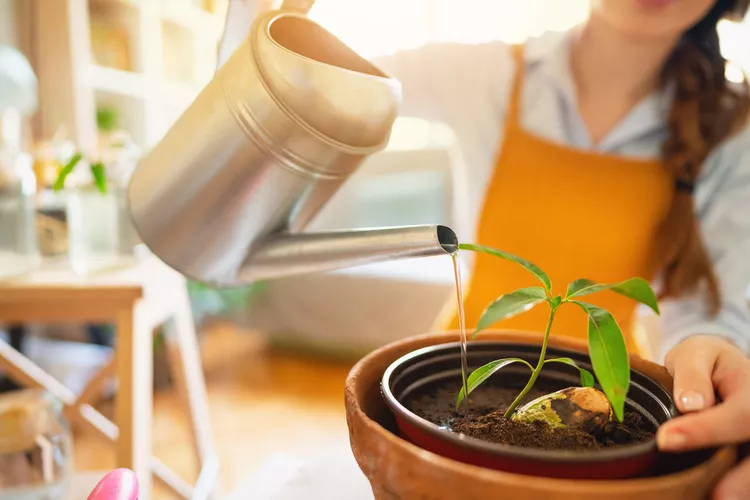
    Once green growth has appeared, take the seedling out of the plastic bag and gently unwrap the paper towel. Place the seedling in your container filled with fresh potting mix at just enough depth to cover most of the seed without covering the new green growth. Keep your new plant's soil consistently moist and put it in a warm, sunny location. If you want to move your new mango plant outdoors, give it one week in dappled shade before placing it in full sun.

How to Care for a Mango Plant

Mangoes are full sun (8+ hours of sun per day) in the tropics; these plants do best with lots of light, warmth, and humidity. If you live in parts of the Southern United States like Florida or coastal Southern California, where frosts are rare, you can plant your mango seedling directly outside. For the rest of the country, mangoes can be grown indoors along a south-facing window. Adding artificial lighting will be necessary in northern climates and areas that do not receive robust and full sun.

Otherwise, caring for your mango tree as a houseplant is as simple as growing other well-known indoor trees, such as the common weeping fig. Give your mango plant a well-balanced fertilizer for the first few years of growth, then switch to a mix higher in phosphorus and potassium. A little goes a long way, so don't be tempted to add more than the package directions indicate. And only apply fertilizers during active growth in the spring and summer.

Be sure to keep the soil moist for the first couple of years. When the seedling has outgrown its first pot, transplant it into a pot one size larger.
Frequently Asked Questions

  • How long will it take before the mango seed provides fruit?

    Like many fruiting trees, mango trees can take quite some time to produce fruit. When started from seed, mango trees can take up to 10 years (or longer) until they are mature enough to produce edible fruit.

  • Can mangoes grow fruit indoors?

    While mango trees can successfully be grown indoors, it's unlikely that your indoor tree will ever produce fruit. The reason is two-fold: In order to fruit, mango trees need a very warm, tropical environment for extended periods of time, which is not easy to come by indoors. Likewise, they can take up to a decade to fruit and are unlikely to live that long (or grow that large) when kept solely indoors.

  • How long does it take a mango to ripen?

    Once the fruit has grown to full size on the tree, it can take up to a week to ripen fully. Mangoes can also be ripened off the tree (like in the grocery store or on your countertop), though the process will be slower.

Related Article

How to Propagate Pothos Successfully in Soil or Water
40.9K
408
61

How to Propagate Pothos Successfully in Soil or Water

Learn how to propagate pothos plants successfully with these simple step-by-step instructions.
24 Easy-Care Houseplants With Low Watering Needs
16.7K
334
93

24 Easy-Care Houseplants With Low Watering Needs

The low-maintenance, easy-care houseplants in this collection add lushness and color to any home without needing much more than occasional watering.
How to Plant and Grow Philodendron
38.6K
772
270

How to Plant and Grow Philodendron

Find growing information on philodendron, the perfect houseplant for new plant owners.
How to Get Rid of Spider Mites on Indoor Plants
46.1K
4.1K
1.9K

How to Get Rid of Spider Mites on Indoor Plants

Spider mites are a common houseplant pest. Learn the early signs of spiders mites on your plants and how to get rid of them.
16 Small Backyard Garden Ideas for Maximizing Your Landscape
36.4K
3.3K
820

16 Small Backyard Garden Ideas for Maximizing Your Landscape

Even the tiniest landscapes can be magical outdoor spaces with these small backyard garden ideas that maximize your yard.
Here's How to Dry and Preserve Flowers to Enjoy Their Beauty Year-Round
37.9K
3K
1.2K

Here's How to Dry and Preserve Flowers to Enjoy Their Beauty Year-Round

Learn how to dry flowers with air drying, silica gel, or even the microwave. These three methods to preserve flowers are great for wreaths, bouquets, and decorating projects.
How to Clean a Hummingbird Feeder in 5 Easy Steps
9.2K
184
51

How to Clean a Hummingbird Feeder in 5 Easy Steps

Keep your garden a safe and welcoming space for hummingbirds by following our five-step guide for how to clean hummingbird feeders.
How to Plant and Grow Angelonia
7K
140
26

How to Plant and Grow Angelonia

Angelonia (or summer snapdragon) is a spectacular addition for continuous color in any garden.
How to Plant and Grow Agapanthus
18.4K
1.8K
330

How to Plant and Grow Agapanthus

Agapanthus is a low-maintenance perennial and landscape staple that produces clusters of trumpet-shaped flowers.
How to Plant and Grow Shrub Roses
40.7K
3.7K
696

How to Plant and Grow Shrub Roses

Learn to grow shrub roses, which combine all of the best characteristics of roses into a beautiful, low-maintenance plant.
11 Best Deer-Resistant Shrubs for Avoiding Browsing Damage
38.2K
1.5K
504

11 Best Deer-Resistant Shrubs for Avoiding Browsing Damage

No plant is completely safe, but these deer resistant shrubs tend to be low on the menu for hoofed garden visitors.
What's Causing Your Gardenia's Yellow Leaves? We Have Answers
16.5K
1.5K
251

What's Causing Your Gardenia's Yellow Leaves? We Have Answers

What causes your gardenia's yellow leaves? Here's the reason and how to fix it. Gardenias are high-maintenance, but this is how to make them happy.
How to Plant and Grow Jasmine
42.3K
3.8K
418

How to Plant and Grow Jasmine

Jasmine is a perennial shrub or vine beloved for its fragrant flowers. Learn how to grow it in your garden or as a houseplant.
Do Deer Eat Tomato Plants? 5 Ways to Protect Your Harvest
42.1K
1.7K
775

Do Deer Eat Tomato Plants? 5 Ways to Protect Your Harvest

Deer do eat tomato plants from time to time. Here's how to recognize deer damage on tomatoes and how to prevent the creatures from ruining your crop.
11 Simple Tips for Growing Carrots in Containers Successfully
31.7K
317
44

11 Simple Tips for Growing Carrots in Containers Successfully

Growing carrots in containers saves space and protects carrot roots from pests. Here's how to plant and grow carrots in pots.
Which Types of Garlic Are Best to Grow in Your Garden?
32.5K
3.2K
1K

Which Types of Garlic Are Best to Grow in Your Garden?

Hardneck or softneck? Here’s what to know about different types of garlic and how to grow them.
How to Plant a Mango Seed and Successfully Grow It in 5 Steps
40.3K
805
152

How to Plant a Mango Seed and Successfully Grow It in 5 Steps

Learn how to plant a mango seed and grow it with only a few basic supplies and a little time. Use this guide to grow a mango seed successfully.
What Is a Fairy Ring? And Will It Harm Your Lawn?
23.4K
2.3K
1.1K

What Is a Fairy Ring? And Will It Harm Your Lawn?

Find out what causes those mysterious circles of mushrooms on your lawn and how to prevent fairy rings.
How to Grow Plants from Cuttings to Fill More Pots for Free
32.7K
981
245

How to Grow Plants from Cuttings to Fill More Pots for Free

Use this simple propagation technique to grow new plants with stem cuttings.
Easy Lawn Repair for Patchy Grass Using Seed or Sod
10.2K
812
292

Easy Lawn Repair for Patchy Grass Using Seed or Sod

With a bit of grass seed or sod, lawn repair is easy, and you’ll soon have a lush green carpet again.