There’s a lot of questionable gardening advice out there that at best does nothing to help your plants thrive and at worst can kill them. And while there may be a grain of truth to some widespread pieces of gardening "wisdom," they don't actually stand up to scientific fact and university studies. We’ve done some digging for you and gotten the real scoop on some popular garden myths.
- C.L. Fornari is a gardening expert and author of Coffee for Roses…and 70 Other Misleading Myths About Backyard Gardening.
- Chelsea McKinley is a plant care health specialist at the U.S. Botanic Garden in Washington, D.C.
1. Drought-tolerant plants don't need to be watered.
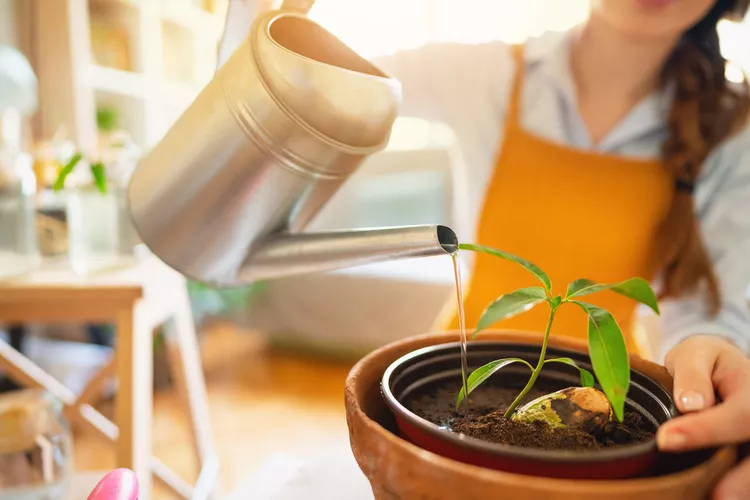
Even the most drought-tolerant plants actually do need to be watered at least the first year they are planted. Tough, drought-tolerant plants like Russian sage, yarrow, and coneflower can live through long, hot summers, but first they're going to need additional water to get their roots established. Give them a layer of mulch that first year, too, to hold in moisture.
Think of that extra water as training wheels for those tough plants. Once they’re a year old, these plants can pretty much fend for themselves. Keep in mind, though, that even the toughest, most drought-tolerant plants can benefit from mulch and a monthly soaking in the summer in an age when the climate is getting more extreme. Drought-tolerant does not mean drought-proof.
2. Adding compost to planting holes encourages root growth.
In the not too distant past, enriching soil in a planting hole with compost or other soil amendments was thought to be a good idea to make it easier for tender new roots to grow. But this has since been proven to do more harm than good.
Backfilling a planting hole with amended soil can cause the plant to have a reduced root system. That's because the roots tend to stay in the improved soil you put in the hole rather than branching out to the surrounding soil, according to the University of Illinois Extension Office.
A better approach is to put a 1- to 2-inch layer of compost around the new plant after you fill up the planting hole with the same native soil you dug out. One exception: If you have heavy clay soil, you should amend with compost to improve drainage.
A planting hole should be twice as wide as the root ball but no deeper. By going wide instead of deep, you encourage the plant roots to grow out, stabilizing the plant and enabling it to find water and nutrients.
3. Gravel in the bottom of a container helps drainage.
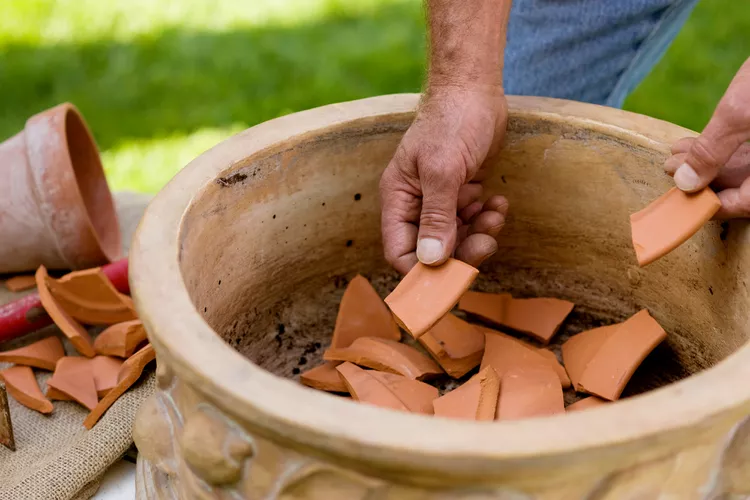
Again, adding pot shards or rocks to the bottom of pots for drainage was once a recommended practice, but it has been found to actually have the opposite effect, preventing water from draining out as easily. A pot with drainage holes at the bottom is all you need to let the excess water drain out so roots stay aerated. You do not need to add a layer of gravel or pot shards to help it out.
“Putting anything at the bottom of the pot is bad for plants,” gardening expert C.L. Fornari writes in her book, Coffee for Roses…and 70 Other Misleading Myths About Backyard Gardening. Studies have shown the movement of water through a potting medium is hindered, not helped, by a layer of coarse material in the bottom of a pot, reports Penn State University Extension. That so-called drainage layer of rocks can also block the drainage hole and keep it from doing its job.
4. Pine needle mulch makes soil too acidic for plants.
Yes, those pine needles have a super-low pH of 3.2 to 3.8 when they fall off the tree (neutral pH is 7.0,). But according to Oregon State University Extension Service, the needles begin to decompose once they hit the ground and soil microbes neutralize the acidity.
“Once they have decomposed, they are closer to neutral,” notes Fornari. “And no, that’s not because their acid is leached into the ground.” If you use fresh needles as mulch, there may be a slight drop in soil pH until they decompose, but not enough to damage plants. Pine needles are a good mulch material that will suppress weeds, hold in moisture, and slowly add nutrients to the soil as they break down.
Similarly, don't rely on pine needle mulch if you want to lower your soil pH around acid-loving plants such as blueberries and azaleas.
5. Watering on hot, sunny days will hurt plants.
Guess what: It’s been raining during the summer for eons and plants have done just fine. This myth may stem from the fact that if you water plants on a hot day, the water will evaporate and not much of it will get to the plant’s roots to hydrate it. That means the plant may still wilt even after you water it. To make sure your plants get the maximum moisture, it's best to apply water in the early morning or in the evening when the sun’s heat has lessened.
If you notice brown spots on leaves, water could be to blame but not because it intensified the sun's rays as some people think. Many fungi and bacteria that cause spotted leaves thrive when foliage gets wet, but this has nothing to do with sunlight. As much as possible, avoid splashing leaves while watering to reduce plant diseases.
6. Dish soap is a natural, safe alternative to pesticides.
Dish soap is not the same thing as insecticidal soap, and it can damage plants. All those recipes for homemade insecticides that use liquid dish soap as an ingredient are largely bogus, warns the University of Florida Extension.
Dish soaps are man-made detergents designed to be powerful chemical cleaners and degreasers. Look closely at their labels: Many liquid dish soaps aren’t even soap, they’re “dishwashing liquid.” They can damage or destroy a plant’s leaves if sprayed on them. Insecticidal soaps, on the other hand, are made to be used on plants and can kill or repel insects without harming plants. They’re also regulated by the Environmental Protection Agency so there’s science behind them.
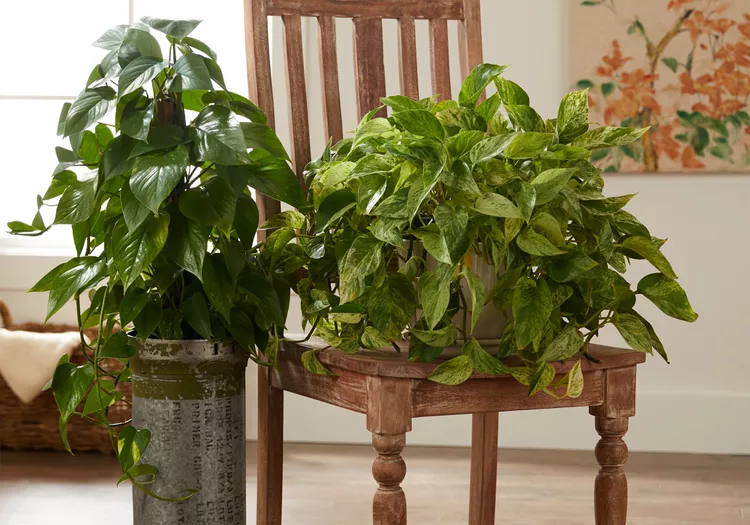
7. Houseplants purify indoor air.
It's a lovely idea, but in reality, houseplants have a minimal impact on indoor air quality. This myth grew out of a NASA study from the 1980s that tested if certain houseplants could remove toxins from the air in a closed environment like a space station. Turns out, yes, some did clean volatile organic compounds (VOCs) like formaldehyde out of the air when they were placed in small, air-tight containers. In the ensuing decades, the Internet became filled with articles citing that study and touting the air-cleaning power of snake plants, ferns, and monstera.
The whole truth is more complex. A 2019 study reviewed a decade’s worth of research on indoor plants’ air-cleaning abilities and determined that houseplants do not improve indoor air quality. The problem with all those experiments was that the small, densely gaseous chambers used in the lab are nothing like your home.
The 2019 study concluded that while plants do remove VOCs from the air, they do it in tiny amounts and at a glacial place. To reduce enough VOCs to impact air quality in your home, the study found, you would need around 10 plants per square foot of living area. That means in a 1,200-square-foot apartment, you’d need 12,000 plants. If you want pure air, buy a mechanical air purifier, not a peace lily.
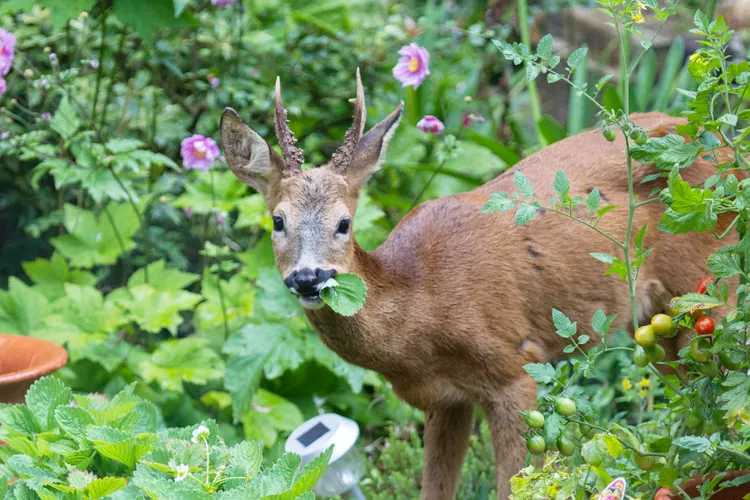
8. Deer-resistant plants on the edge of a yard will keep deer out.
As the Michigan State University Extension Service puts it, deer haven’t survived for eons by being food-stupid. They may be momentarily off-put by rosemary, cast iron plants, ferns, and other plants they don’t find tasty in their path. But it's only a matter of time before they find your delicious hydrangeas, hostas, and daylilies. Thinking otherwise is like believing your teenager won’t eat cookies if you put them next to kale chips.
The most effective way to keep deer out of your yard and garden is an 8-foot-tall fence. Otherwise, try a deer repellent and put it on the plants they like to eat. Reapply it after every rain.
9. Coffee grounds are a good natural fertilizer.
Tossing your used coffee grounds around your plants won’t actually do much good. Coffee grounds are high in nitrogen, a key nutrient for plants, but it’s not in a form that’s readily available to plants, says Chelsea McKinley, plant care health specialist at the U.S. Botanic Garden in Washington, D.C.
“The best way to use coffee grounds in a gardening is to compost them,” McKinley says. “You’ll get the full potential out of them if you compost them and then use that compost to fertilize your plants because then the nutrients are more readily available and in proportions more appropriate for plant growth.” And no, coffee grounds don’t acidify soil, either.